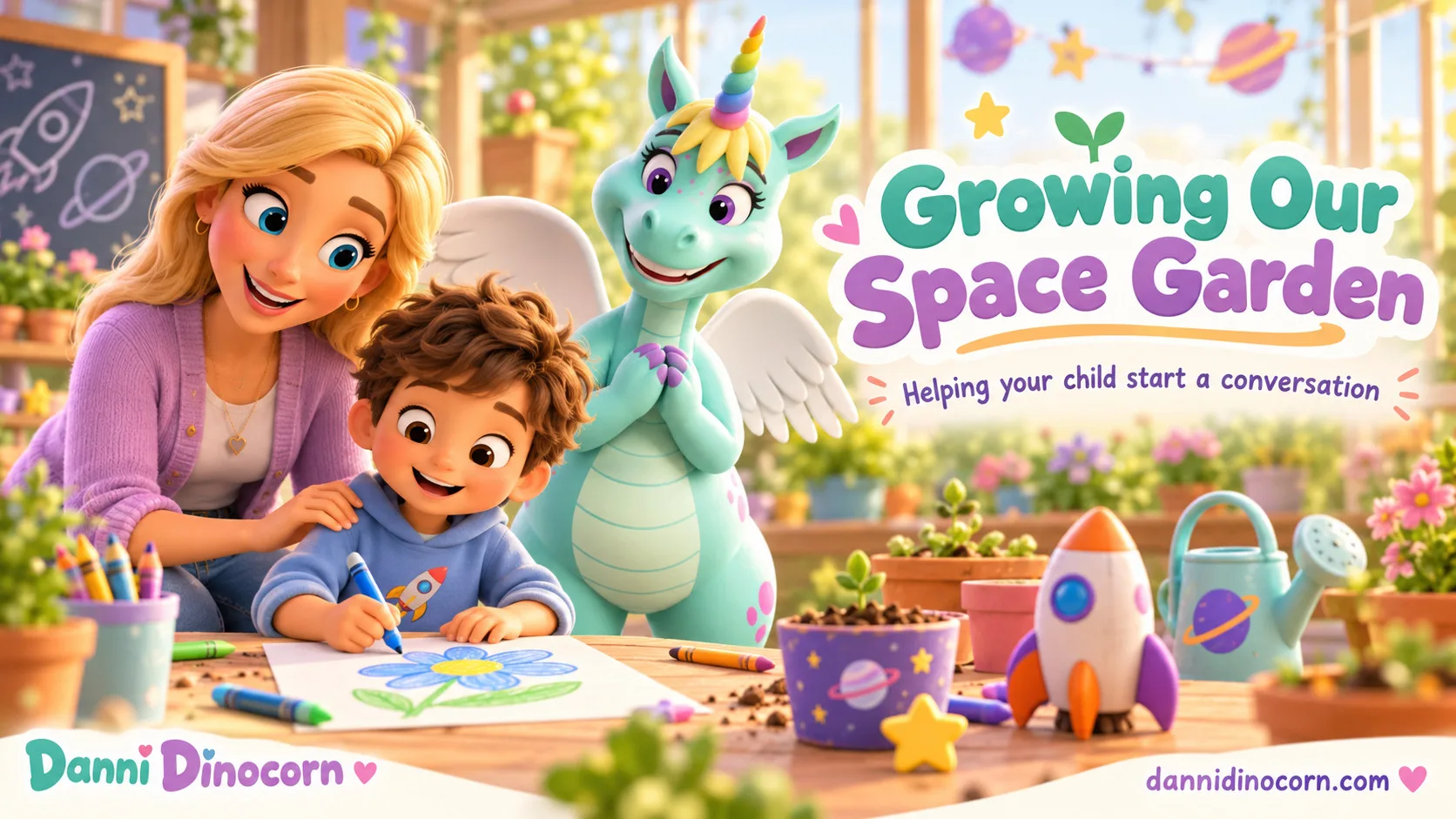
Helping your child take the first step towards a conversation.
Imagine your child standing at the edge of a busy playground, hoping to join in but wondering, “What if they don’t answer?” or “What if they say no?”
In our Space Garden, children are astronauts exploring an unfamiliar universe. Parents travel alongside them: we can help them learn to steer and navigate while leaving room for them to take the lead. Some children start conversations easily; others need more time, modelling, and practice. Hanging back does not necessarily mean that a child is unfriendly or uninterested. They may still be developing the skills that help them connect with others in a way that feels manageable.
Planting the first seed in your child’s space garden.
Parents can plant the first seed in their child’s space garden by helping them notice what is happening, think of something to say, approach someone, and manage whatever happens next. “Just go and talk to a friend” can feel like telling an astronaut to fly without showing them the controls.
Social skills are learned, and children develop them at different rates. Children also notice, interpret, and respond to social information in different ways. These differences can shape how they interact with their peers (Crick & Dodge, 1994; Ladd, 1999; Darling et al., 2021).
These skills become easier to understand when they are broken into a simple launch sequence.
A simple launch sequence to practice together.
Think of NOTICE → ASK → SHARE as a simple launch sequence you can practice with your child.
For example: “I saw your Pokémon cards. Which one is your favorite? Mine is Charizard.”
Or: “I noticed you are drawing. What are you making? I like drawing animals.” Keep it simple; children do not need a perfect opening line or a lengthy conversation.
Parents, let’s practice launching our spaceships together.
Keep practicing the launch sequence in a light and playful way, like a short flight-training session. Before a party, think up a first sentence together, such as, “Hi, what are you playing?” At home, take turns role-playing a short exchange: one person says they are drawing, and the other asks, “What are you making?” In everyday settings, your child might greet a cashier, ask a simple question, or say thank you.
As you practice, offer ideas, then give your child a turn at the controls. Practicing with a parent can help children try social skills in a comfortable setting (Pacia et al., 2022).
Celebrate every launch and seed planted!
Some social attempts may feel awkward, and a chat may end quickly. That is still useful practice. Each launch helps your child learn to navigate, and each attempt plants a seed in their social/space garden. You might say, “I noticed you went over and tried. That took courage.” When your child is ready, ask, “What might you try next time?” Celebrate the effort rather than expecting a particular outcome.
Now put this encouragement into practice with one small Space Garden Challenge.
Choose one small social skill to practice this week: saying hello, asking a question, giving a compliment, or sharing an interest. Try it together at home, then look for a comfortable moment to use it out in the world.
It does not have to be perfect. Every greeting, question, or shared laugh is a seed, and every brave attempt helps confidence grow. Celebrate the effort and enjoy watching your child’s social garden bloom. Then keep an eye out for our next blog, where we will explore another small step in the journey.
References
Crick, N. R., & Dodge, K. A. (1994). A review and reformulation of social information-processing mechanisms in children’s social adjustment. Psychological Bulletin, 115(1), 74–101. https://doi.org/10.1037/0033-2909.115.1.74
Darling, S. J., Goods, M., Ryan, N. P., Chisholm, A. K., Haebich, K., & Payne, J. M. (2021). Behavioral intervention for social challenges in children and adolescents: A systematic review and meta-analysis. JAMA Pediatrics, 175(12), e213982. https://doi.org/10.1001/jamapediatrics.2021.3982
Ladd, G. W. (1999). Peer relationships and social competence during early and middle childhood. Annual Review of Psychology, 50, 333–359. https://doi.org/10.1146/annurev.psych.50.1.333
Pacia, C., Holloway, J., Gunning, C., & Lee, H. (2022). A systematic review of family-mediated social communication interventions for young children with autism. Review Journal of Autism and Developmental Disorders, 9(2), 208–234. https://doi.org/10.1007/s40489-021-00249-8
Conversation prompts
NOTICE
Comment on something nearby: “That drawing looks cool” or “Are you playing tag?”
ASK
Try an easy, in-the-moment question: “What are you playing?” or “Which team are you on?”
SHARE
Offer a little about yourself: “I like drawing too, or I like playing tag.”
This resource is provided for psychoeducational purposes only. It is not intended to diagnose or treat psychological or mental health conditions and should not replace an individual assessment or professional advice from a registered healthcare practitioner.